
.png)
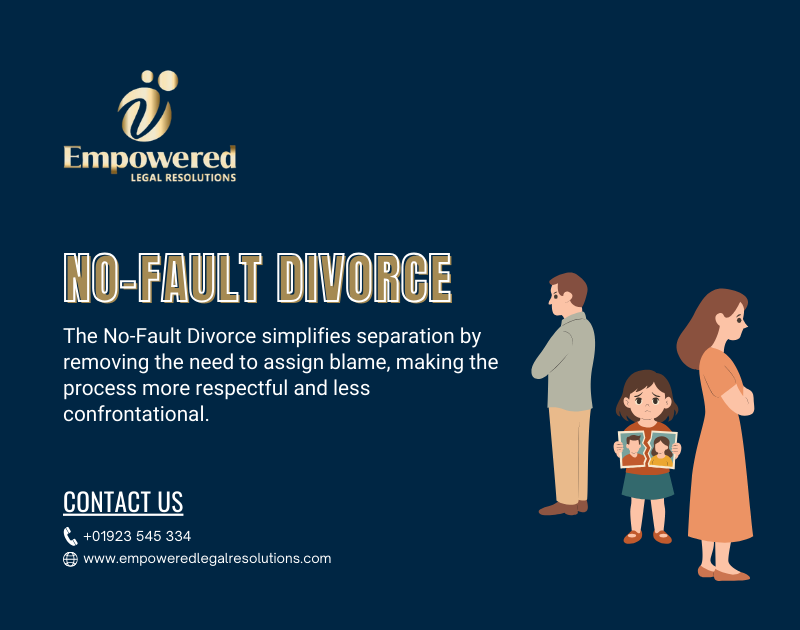

Empowered Legal Resolutions – Understanding No-Fault Divorce
Divorce is one of life’s most significant transitions, often accompanied by emotional strain, uncertainty, and difficult decisions. For many years, the legal process itself added further stress by requiring couples to assign blame in order to bring their marriage to an end. The introduction of No-Fault Divorce in 2022 marked a major shift in UK family law, transforming the way couples can separate with dignity, clarity, and less conflict.
Empowered Legal Resolutions, we believe that legal processes should support healing rather than deepen distress. The no-fault divorce system reflects this philosophy, offering a simpler, more respectful route through divorce while still ensuring proper legal safeguards are in place.
This article explains what no-fault divorce is, how it works, and what it means for you if you are considering ending your marriage.
What Is No-Fault Divorce?
No-fault divorce was introduced in England and Wales in April 2022, replacing the previous fault-based system that had been in place for decades. For most people, it has been a welcome and much-needed change.
Under the old system, one party had to prove that the marriage had irretrievably broken down by relying on one of five specific grounds. These often required allegations of blame or lengthy periods of separation, which could inflame tensions and complicate an already emotional process.
The new no-fault divorce system removes the requirement to prove wrongdoing. Instead, it allows couples to focus on moving forward, rather than remembering and documenting the reasons their relationship failed.
The Old Grounds for Divorce - A System Based on Blame
Before no-fault divorce, a party seeking a divorce had to rely on one of the following five grounds to demonstrate that the marriage had broken down irretrievably:
1. Adultery
2. Unreasonable behaviour
3. Desertion
4. Two years separation with consent
5. Five years separation without consent
In practice, many couples who wished to divorce quickly felt compelled to rely on adultery or unreasonable behaviour, even when both parties agreed that the marriage was simply no longer working. This often led to unnecessary conflict, resentment, and emotional harm.
The no-fault divorce system was designed to remove these barriers and reduce hostility, particularly where children are involved.
What Has Changed Under No-Fault Divorce?
The most significant change is that proof of divorce is no longer required. There is no need to assign blame, provide evidence of behaviour, or wait years for separation periods to expire.
Instead, a party (or both parties jointly) must simply provide a statement confirming that the marriage has broken down irretrievably. Under the new law, this statement alone is treated as conclusive evidence. The court cannot investigate, challenge, or reject it.
This change reflects a modern understanding that relationships end for many complex reasons, and that forcing couples to justify those reasons serves no constructive purpose.
Who Can Apply for a No-Fault Divorce?
To apply for a divorce in the UK, the following requirements must be met:
1. The marriage must have lasted at least one year
2. The applicant must confirm that the marriage has irretrievably broken down
3. The court must have jurisdiction (for example, based on habitual residence or domicile)
If these criteria are met, the divorce process can begin.
Sole or Joint Applications - Your Choice
One of the most positive features of the no-fault divorce system is the flexibility it offers in how applications are made.
Sole Application
A sole application is made by one party. This may be appropriate where:
1. Communication has broken down
2. One party does not wish to engage
3. There is an imbalance of power or trust
Only the applicant is required to confirm their intention to proceed at the relevant stage.
Joint Application
A joint application is made by both parties together. This can help:
1. Reduce conflict
2. Encourage cooperation
3. Promote a more amicable separation
In joint applications, both parties must confirm to the court that they wish the divorce to proceed.
Empowered Legal Resolutions, we advise clients on which option best suits their circumstances, ensuring their interests are protected at every stage.
The Four Main Stages of the No-Fault Divorce Process
The no-fault divorce process follows a clear, structured pathway designed to allow time for reflection while avoiding unnecessary delay.
1. Divorce Application
The process begins with the submission of a divorce application to the court, either solely or jointly. This application includes a statement confirming that the marriage has broken down irretrievably.
No supporting evidence or explanation is required.
2. Minimum 20-Week Waiting Period
Once the application has been issued by the court, there is a mandatory minimum 20-week waiting period. This period is designed to:
1. Allow time for reflection
2. Encourage consideration of reconciliation (where appropriate)
3. Enable couples to resolve financial and child-related arrangements
After the 20 weeks have passed, the applicant(s) may confirm that they wish the divorce to continue.
3. Conditional Order
Following confirmation, the court will grant a Conditional Order (previously known as the Decree Nisi). This confirms that the court sees no legal reason why the divorce should not proceed.
The marriage is not yet legally ended at this stage, but it marks a significant milestone in the process.
4. Final Order
The Final Order (formerly the Decree Absolute) legally ends the marriage. This can be applied for six weeks and one day after the Conditional Order is granted.
Once the Final Order is issued, the parties are legally divorced.
Why the Waiting Period Matters
While some people are eager to complete the process as quickly as possible, the waiting periods built into the no-fault divorce system serve an important purpose. They provide:
1. Time to address finances and property
2. Space to make arrangements for children
3. An opportunity to seek legal advice
Empowered Legal Resolutions, we ensure clients understand the strategic timing of each stage, particularly where financial settlements are still being negotiated.
Divorce and Financial Matters - A Separate but Crucial Issue
It is important to understand that divorce itself does not resolve financial matters. Even after a Final Order is granted, financial claims can remain open unless they are formally concluded through a financial order.
Seeking legal advice early allows you to:
1. Protect your financial position
2. Avoid unintended consequences
3. Ensure long-term security
Our team works alongside you to ensure divorce proceedings and financial matters are aligned and handled appropriately.
The Benefits of No-Fault Divorce
The introduction of no-fault divorce has brought several key benefits:
1. Reduced conflict and blame
2. A more respectful process
3. Greater cooperation between parties
4. Improved outcomes for children
5. Lower emotional and legal costs
While divorce is never easy, the new system makes it more humane and constructive.
How Empowered Legal Resolutions Supports You
Empowered Legal Resolutions understands that every divorce is unique. Our role is not simply to process paperwork, but to guide you through this transition with clarity, empathy, and expertise.
We support clients by:
1. Explaining the process in plain English
2. Advising on sole or joint applications
3. Managing court procedures efficiently
4. Providing strategic guidance alongside emotional support
5. Offering a free 20-minute telephone consultation
We believe informed clients make empowered decisions.
Taking the First Step with Confidence
If you are considering divorce, or simply want to understand your options under the new no-fault system, seeking advice early can make a significant difference. Knowing what to expect helps reduce anxiety and ensures you move forward with confidence.
Conclusion - A Modern Approach to Divorce
The introduction of no-fault divorce represents a positive shift in family law, one that prioritises dignity, fairness, and emotional wellbeing. By removing blame and simplifying the process, it allows couples to focus on resolution rather than conflict.
Empowered Legal Resolutions, we are here to support you at every stage of your journey. Whether you are seeking information, reassurance, or practical guidance, our experienced team is ready to help you take the next step.
Contact Empowered Legal Resolutions today for a free 20-minute telephone consultation to discuss your situation and explore your options with confidence and clarity.
Thank you for reading our blog article, please keep in touch for more knowledgeable content,